Laminate Mid Century Modern Cabinet Doors
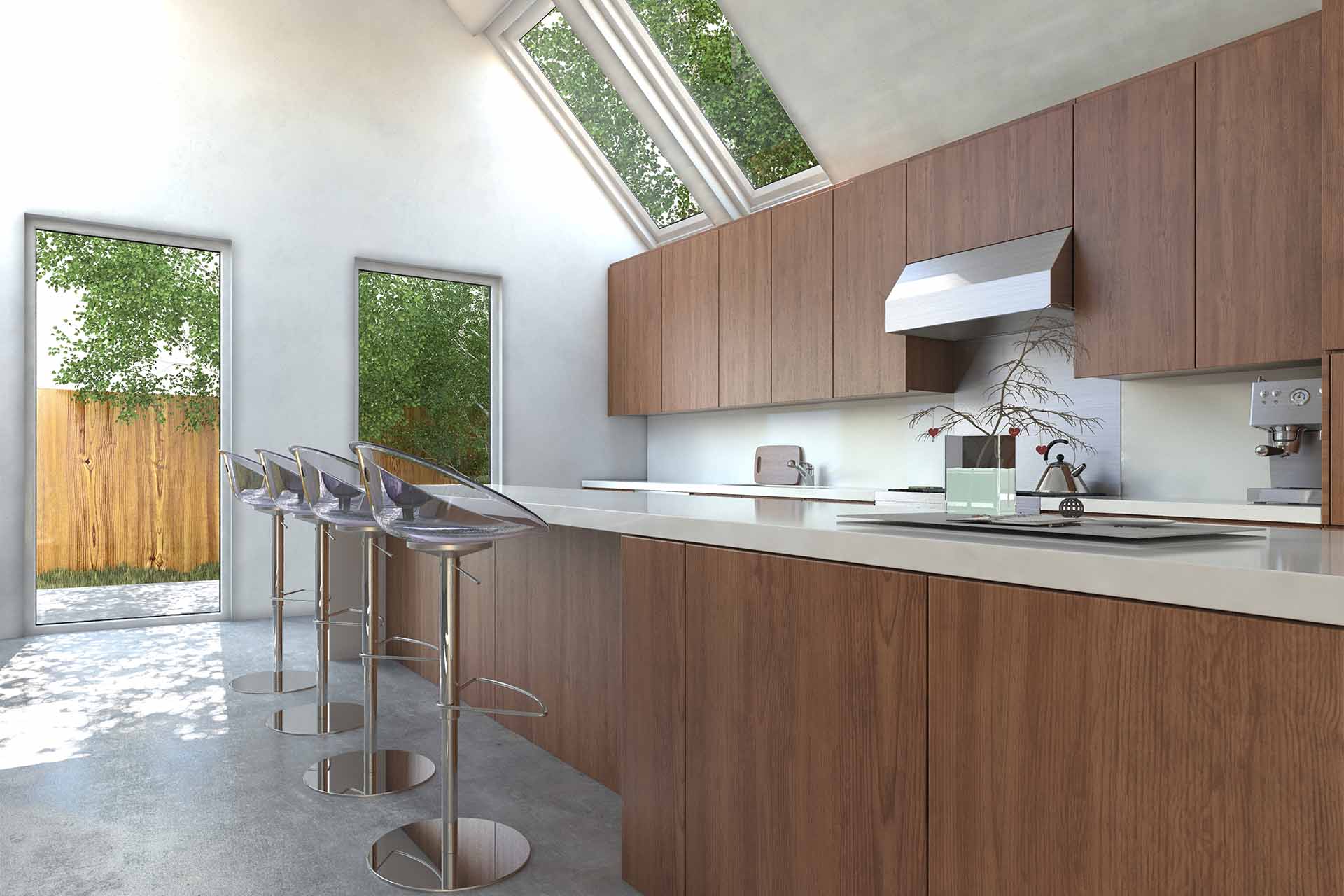
The word laminate carries associations from the wrong era. Thin surfaces with printed wood grain that peeled at the edges. Kitchens from the 1980s that were considered contemporary at the time and dated within a decade. Modern laminate, specifically high pressure laminate or HPL, is a different product with different properties and a different role in mid century modern cabinetry.
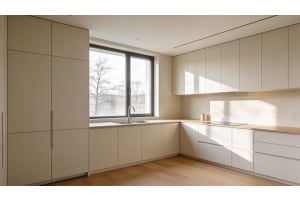
HPL is the material behind most contemporary flat slab cabinet doors that are not wood veneer. In the right context it is a legitimate, durable, and well-considered choice for mid-century cabinet specifications. The flat slab profile suits it particularly well.
What HPL Is and Why It Differs from Standard Laminate
HPL is produced by bonding multiple layers of resin-saturated kraft paper under high heat and pressure, creating a dense, hard surface material. The face layer, which determines color and texture, is included in the same pressing process rather than applied afterward. The result is a material that is significantly harder and more durable than standard laminate, which uses lower pressure and fewer layers.
Standard laminate is glued to a substrate after manufacture. HPL is produced as a unified material. This difference matters for edge quality, durability in high-use areas, and moisture resistance, all of which are relevant for cabinet doors in a kitchen or bathroom environment.
Why Slab Cabinet Doors Suit Mid-Century Modern HPL
Slab cabinet doors have no separate panel and no raised or recessed detail on the face. The door is one flat surface, which means the material covers the entire face without interruption. This is where HPL performs well: the uniformity of color and texture across the full door face is a quality of the material rather than a limitation.
In a wood veneer slab door, the visual interest comes from natural grain variation that differs between panels and shifts with the light. In an HPL slab door, the visual interest comes from consistent color and texture at scale. Mid-century modern design is comfortable with both approaches because both present the material honestly.
The flat slab profile also weatherproofs HPL better than a framed door would. There are no joints between frame members and panel to allow moisture ingress. The door is one sealed surface, which suits the performance requirements of a kitchen environment.
How Laminate Cabinet Doors Compare to Veneer
The main practical differences between HPL laminate and real wood veneer in a flat slab cabinet door are grain authenticity, surface feel, moisture resistance, price, and the way the material reads in different light conditions. Veneer has natural grain variation that makes each panel unique. HPL has more controlled and consistent color, which can be an advantage when uniformity is the specification goal.
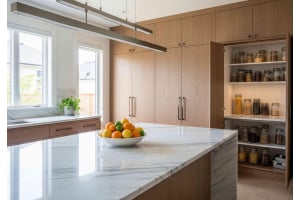
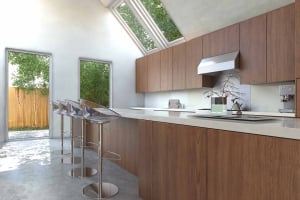
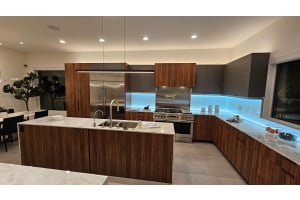
For homeowners who want the authentic grain quality of a natural material, real wood veneer cabinet doors remain the closer choice to the original MCM material palette. The grain in real oak veneer shifts across the day in a way that a printed or manufactured surface cannot replicate, and that shift is part of what makes the material feel warm rather than designed.
HPL performs better where moisture resistance is the priority: near a sink, around a dishwasher, in a bathroom. The non-porous surface of HPL does not absorb water, and the edge bands bond more reliably to the denser substrate.
Drawer Fronts and the Importance of Consistency
Drawer fronts in an HPL slab cabinet run should match the door panels exactly: same surface color and texture, same edge treatment, same hardware. This is where custom sizing matters. Off-the-shelf drawer fronts in standard dimensions rarely align with bespoke cabinet configurations, and any visible inconsistency in the surface material breaks the rhythm of the run.
The advantage of ordering custom HPL slab cabinet doors and drawer fronts as a single batch is that the face material is from the same production run, ensuring color consistency throughout the installation. HPL colors can vary between batches, and mixing separately ordered components carries a risk of visible variation that is difficult to resolve.
Fronts for open shelving brackets or base cabinet toe kicks, if specified in the same HPL, should also be ordered at the same time to guarantee consistency across the complete installation.
Door Profiles and Edge Treatment Quality
The quality of an HPL slab cabinet door is often revealed by the edge. A thin, poorly matched edge band applied to a low-density substrate draws the eye and undermines the clean single-surface appearance the flat slab door depends on. In a well-made HPL door, the edge band is the same material as the face, applied with precision, and effectively invisible.
Door profiles in HPL slab cabinet doors are typically square-edged or very slightly eased. Any more profile than a light ease moves the door away from the mid-century modern vocabulary and toward a more decorative contemporary direction.
Frequently Asked Questions
Are laminate cabinet doors good?
HPL laminate cabinet doors are a genuinely good choice for most kitchen and bathroom environments. They are durable, moisture-resistant, easy to clean, and consistent in finish. The main difference compared to wood veneer is the absence of natural grain variation. In terms of longevity and practical performance, HPL is competitive with any other cabinet door material.
How to make a cabinet look mid century modern?
The door profile is the first decision: a flat slab is required. An HPL slab door in a matte finish, with simple bar pull hardware and a consistent color across the entire run, delivers the mid century modern aesthetic in a practical and durable format. The matte surface finish matters: gloss HPL pushes the result toward contemporary rather than MCM.
What color kitchen is in for 2026?
Natural wood tones remain the dominant direction, and HPL laminates with wood-grain surface textures, particularly light oak and natural oak patterns, reflect this. For solid color HPL, warm off-whites and soft warm neutrals are more consistent with current kitchen design than the cooler greys that led the market in the previous decade.
The decision between a flat slab door and a shaker door often comes down to how the material will read at scale. Understanding the structural differences between slab and rail cabinet doors, how each is built and why that construction matters, makes the final specification considerably more straightforward.