Slab vs Rail Cabinet Doors: What Are the Differences?
Cabinet doors fall into two structural categories. A slab door is one flat piece of material with no frame and no separate center panel. A rail-and-stile door uses a frame made up of vertical and horizontal members surrounding a center panel. Everything else in cabinet door design is a variation on these two approaches.
The differences between them affect how the door looks, how it is built, how much it costs, and which design directions it belongs to. Understanding both makes it easier to specify the right door for a given room.
What Are Slab Cabinet Doors?
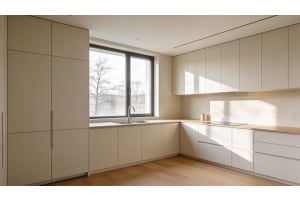
Slab cabinets are flat-panel cabinet doors built from a single substrate with no extra details on the face. Slab doors have no frames: they are solid slabs of material with no visible construction on the face. The door is one flat piece of material with a matching edge band and, where specified, hardware applied directly to the face. No frame, no rail, no center panel sitting within a frame.
Slab doors are made from dimensionally stable composite materials, almost always MDF material covered with veneer, HPL, lacquer, or paint. The edge is finished with a banding material that matches or complements the face. In a quality slab cabinet door, the edge band is effectively invisible: the door reads as one continuous surface.
What Are Rail-and-Stile Cabinet Doors?
A rail-and-stile door uses five-piece detail construction: two vertical stiles that run the full height of the door, two horizontal rails at the top and bottom, and one center panel that sits within the frame. The frame is always visible on the face. This is the defining feature of rail-and-stile door design.
The center panel in a rail-and-stile door can be recessed below the level of the frame, which is the shaker configuration, raised at or above the level of the frame with a profiled edge, which is the traditional configuration, or flat within the frame, which is a contemporary version. Each variation produces a different visual result but uses the same underlying five-piece construction.
Recessed Panel and Raised Panel: The Two Main Variations
A recessed panel sits below the level of the surrounding frame. This is the shaker door. The shadow line between the frame and the panel creates visible depth and is the characteristic visual feature of the shaker style. Shaker cabinets feature this detail across every door and drawer front in the run.
A raised panel sits at or above the level of the frame with a profiled edge that transitions from the field of the panel down to the frame. This is the door design of traditional and period kitchens. The profiling can be simple or elaborate, and the degree of profiling is often what signals the historical period being referenced.
Both variations use the same five-piece detail construction. The door design differs at the center panel, but the visible frame remains in both cases and is what distinguishes rail-and-stile doors from flat slab door panels.
How Slab Cabinet Doors Take Shape
Slab cabinet doors take their shape from the substrate. A sheet of MDF or particleboard is cut to the door size, the face material is applied to both sides, and the edge is banded. There is no separate panel to fit within a frame and no frame to assemble. Slab doors are made to exact customer measurements rather than standard sizes, which allows them to fit any cabinet opening precisely without adjustment.
The one flat piece approach has a practical advantage beyond appearance: there are no joints between construction elements that could open over time with changes in humidity. The door is a single sealed unit, which performs consistently across normal environmental conditions.
Slab Doors Are the Right Choice for Mid-Century Modern Design
In a mid-century modern interior, slab cabinet doors are the correct profile. This is not a stylistic preference, it is a matter of design language. Very modern and minimalist approach kitchens from the mid century period specifically rejected the visible frame construction of traditional cabinetry. The flat slab was a statement about what cabinetry should be: honest, flat, and defined by its material rather than its construction.
Scandinavian designs from the same period applied the same logic. The flat panel with no extra details was understood as the contemporary solution to storage. Both mid century modern and Scandinavian design traditions arrived at the slab door through the same reasoning, which is why the two styles are often compatible in mixed interiors today.
For anyone specifying mid century modern cabinetry, light oak wood veneer slab cabinet doors from 27eStore deliver the flat profile, the natural material, and the grain quality the style requires, custom-sized to any configuration with the grain running consistently across the full face of each door.
Cost and Cabinetry Quality Differences
Slab cabinet doors are generally less expensive to produce than rail-and-stile doors at equivalent quality levels. The reason is simpler construction: fewer components, no frame assembly, and no panel fitting. A quality flat slab door in a wood veneer is typically less expensive than a shaker door in the same veneer at the same specification level.
The quality indicator in a slab door is the edge. A well-made slab door has an edge band that is the same material as the face, bonded cleanly and sanded flush. An inset or island application of a slab door, where the door sits within the face frame of the cabinet rather than covering it, requires tighter tolerances and is a mark of a more considered installation.
Are Slab Cabinet Doors in Style?
Slab cabinet doors are in style and have been consistently present in contemporary and mid century modern kitchen design for over fifty years. The profile itself is a design constant. The finishes chosen within the flat slab category shift with trends: light oak and natural wood tones are strongly current, matte white has been consistent for two decades, high-gloss white is less prevalent than it was at its peak.
The more useful question is whether a specific slab door finish suits the room. The profile accommodates almost any material direction, which is part of its sustained relevance. Styles that depend on a specific surface pattern or decorative treatment date when that treatment goes out of fashion. The flat slab door, by avoiding all of that, remains relevant across design cycles.
Frequently Asked Questions
What are the cons of slab kitchen cabinets?
The flat surface shows fingerprints and surface marks more readily than a textured or framed door, which requires more frequent cleaning in high-use areas. The door's visual success depends almost entirely on the quality of the face material and edge treatment. There is no decorative detail to distract from any surface imperfection. And the style commits to a contemporary or mid century direction, which may not suit every homeowner's existing furniture or the character of an older property.
Are slab cabinet doors in style?
Yes. The flat slab profile has been consistent in contemporary kitchen design for decades and shows no signs of declining. The finish choices within the slab category shift with trends, but the profile itself is a design constant. The more budget friendly option being laminate, with the premium option being real wood veneer.
What is the 1-3 rule for cabinet doors?
The 1-3 rule is a proportion guideline suggesting that open and closed storage, or upper and lower cabinet proportions, should relate in roughly a 1-to-3 ratio for balanced visual weight. In a cabinet wall with both open shelving sections and closed slab doors, approximately one unit of open storage for every three units of closed storage produces a composition that reads as intentional.
What is the trend in cabinet hardware in 2026?
Bar pulls in matte black and brushed brass are the two strongest hardware directions in current kitchen design. Integrated finger pulls, routed channels rather than applied hardware, continue to grow in popularity for a fully minimal look. The direction is toward hardware that is either simple and clearly visible or completely concealed. Decorative knobs and cup pulls are receding from the contemporary kitchen.