If you have been reading British or European kitchen design coverage, you have probably run into a word that does not appear on many American floor plans. It sounds old fashioned, and in one sense it is. But the idea behind it has quietly become one of the most requested features in new kitchen layouts on both sides of the Atlantic.
A Larder, Defined
A larder is a dedicated place for keeping food, traditionally a cool area of the house used to store food items that require low, stable temperatures. Before mechanical refrigeration, it was the primary method of keeping perishables edible through the week.
The Original Cool Room
In older homes it was a small room with a north facing wall, a stone or slate slab, and a vent to the outside. The cool temperature did the work. Meats, dairy, and preserves went on the slab; dry goods went on shelves above. It sat somewhere between a cellar and a modern refrigerator in function, and in larger houses it was often a walk in space next to the kitchen rather than a piece of furniture.
The Kitchen Larder Today
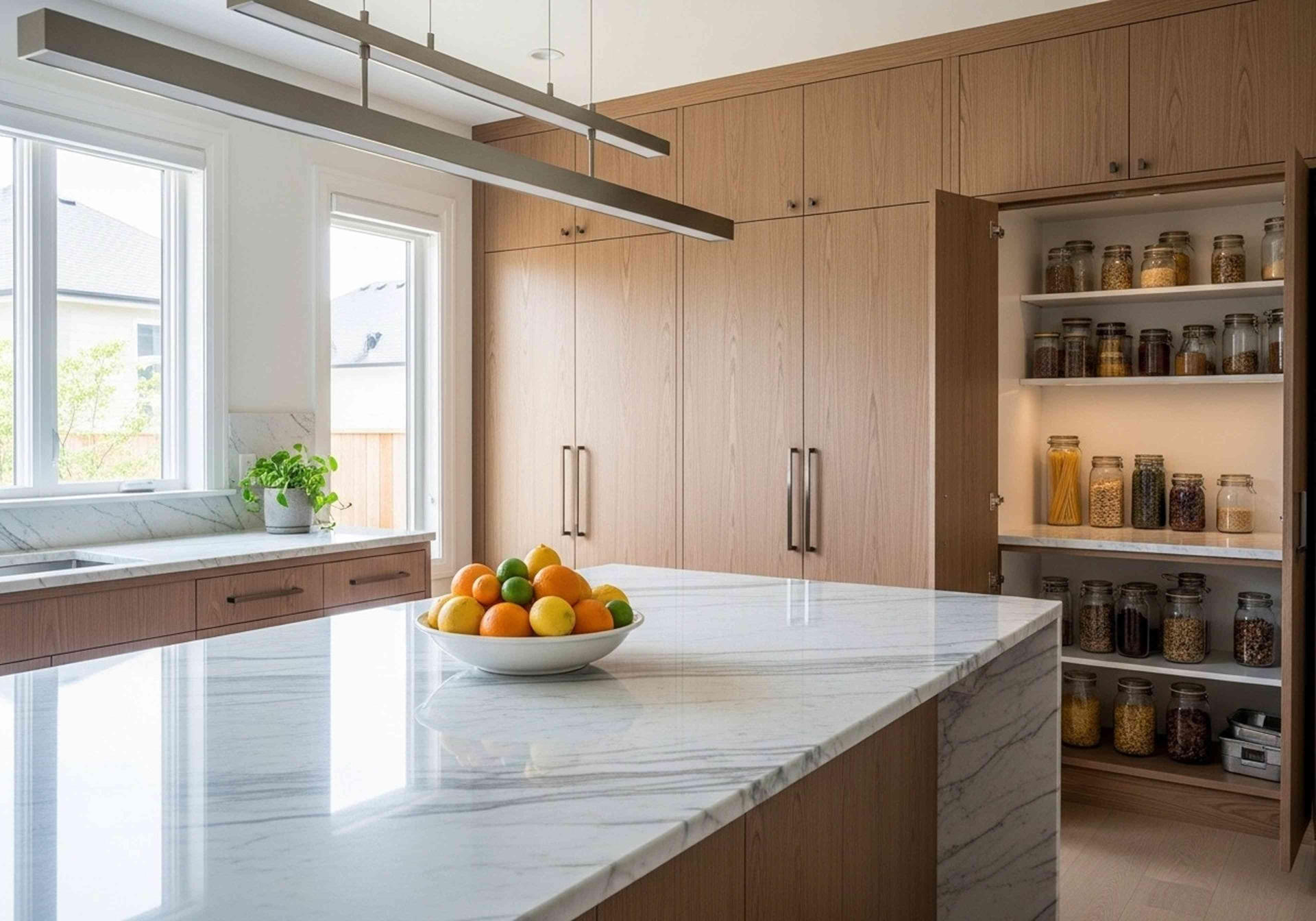
What survives in current design is not the room but the cabinet. A modern kitchen larder is a tall cupboard designed around the same principle: everything you reach for while cooking, gathered behind one pair of doors, arranged so you can see it all at once. The cool temperature requirement largely disappeared with refrigeration, so what remains is the organizational logic.
Where the Word Comes From
It traces back through Old French to the Latin lardum, meaning bacon or cured fat. The original purpose was storing meats that had been salted or cured, and the name stuck long after its contents broadened. Any English dictionary still lists larder primarily as a place where food is stored, which is why the term reads as archaic to American ears and as ordinary to British ones.
Larder vs Pantry Cabinet: What Actually Differs
The two words describe overlapping ideas, and in everyday use people treat them as interchangeable. Historically they were not.
| Traditional larder | Traditional pantry | |
|---|---|---|
| Original purpose | Perishables kept cool | Dry goods, bread, tableware |
| Temperature | Deliberately cool and vented | Ambient |
| Typical form | Cool room, later a tall cupboard | Closet or shelved cabinet |
| Common region | UK, Ireland, parts of Europe | North America |
| Modern usage | Tall cabinet with fitted interior | Tall cabinet or walk in closet |
What Americans Call It
In the United States the everyday equivalent is the pantry, or more specifically the tall pantry cabinet. If a designer shows you a British kitchen and points out the larder, the closest American term for the built in version is a tall pantry unit, and for the walk in version, a butler's closet. The functional difference between the two traditions has mostly collapsed.
Where the Two Overlap
Both now describe the same thing in practice: concentrated food storage close to where you cook. What the British term carries that the American one does not is an expectation about the interior. A basic tall cupboard can be three fixed shelves and a door. The larder tradition implies fitted drawers, racks, and a considered layout.
What Goes Inside
The contents are what justify the cabinet. A well planned interior holds more than an equivalent run of wall units because nothing is stacked behind anything else.
Dry Goods and Jars
- Flour, sugar, rice, pasta, and cereal, usually decanted into jars for visibility
- Oils, vinegars, and condiments on a shallow door rack
- Spices in a single tier so labels face out
- Tea, coffee, and drinks supplies grouped together
- Baking equipment and tins on a lower shelf
Small Appliances
The strongest argument for this format in a contemporary kitchen has nothing to do with keeping food cool. It is the stand mixer, the air fryer, the toaster, and the coffee machine. Housing small appliances behind doors clears the counter without exiling them to a basement shelf, and it is the reason the format has returned to popularity.
Features That Make a Larder Cupboard Work
Depth is the first decision. A large cupboard at standard base depth swallows items at the back; a shallower box with door racks keeps everything visible. Most well designed examples split the difference, using a deeper lower section for appliances and a shallower upper section for smaller items.
Adjustable Shelves and Interior Drawers
Fixed shelving is the single biggest limitation in a tall food cabinet. Adjustable shelves let the interior change as your habits change. Interior drawers behind the doors solve the depth problem outright, since a drawer brings its contents to you rather than making you reach past the front row.
A Worktop Shelf
A fixed shelf at counter height, with the section above left open when the doors are, turns part of the cabinet into a working surface. This is where a coffee station or a breakfast setup lives. It needs power, which is job site electrical work rather than something built into the cabinet, so plan the outlet with your electrician during rough in.
Ventilation and Cool Temperature
If you want any of the original function, a vented back panel and a position on an exterior wall away from the range will keep the interior a few degrees below ambient. Worth doing if you store root vegetables or preserves. Unnecessary for most modern uses.
Freestanding or Built In?
You can buy a standalone piece of furniture that performs this role, and plenty of people do. It moves with you, requires no installation, and suits a rental. The tradeoff is that it reads as furniture rather than architecture, and it rarely matches the cabinetry around it. A built in version integrates with the run and uses the full height of the wall, which a furniture piece almost never does. We cover that comparison in detail in our guide to freestanding pantry cabinets.
How to Organize the Interior
- Zone by task, not by category. Baking in one place, breakfast in another, so you open the doors once per activity.
- Keep daily items at eye level. Occasional items go high, heavy items go low.
- Decant staples into matching containers. This is as much about seeing what you have as about appearance.
- Use the door. Shallow racks on the inside face hold a surprising amount and cost no floor area.
- Leave one shelf empty. Groceries arrive in waves and need somewhere to land.
Getting the Same Food Storage from Pantry Cabinets
You do not need the vocabulary to get the result. A tall cabinet specified with the right interior does everything described above, and in a frameless European build the full width of the box is usable because there is no face frame narrowing the opening. Our pantry cabinets are built to order, so the interior is configured at quote rather than chosen from a fixed set of options.
Interior Drawers
Drawers behind full height doors are the most useful single upgrade. They suit dry goods, tins, and anything that would otherwise be buried, and they are specified per cabinet rather than retrofitted later.
Full Height Pull Out Units
A narrow cabinet where the entire interior frame slides out on heavy duty runners is the closest direct equivalent to the fitted British units. It works well in tight widths between appliances. It is a more specialized configuration and less commonly ordered, but it is available.
Is It Worth It in an American Kitchen?
If you are already planning tall cabinetry, yes, because the cost difference is in the interior fittings rather than the box, and fitted interiors are what make the difference between storage you use and storage you forget. If you have a walk in food closet already, the case is weaker; you would be duplicating capacity. The strongest case is a mid sized kitchen with no closet to spare, where one well fitted tall unit replaces the function of a small room. Most kitchens fall into that middle group.
Frequently Asked Questions
What do Americans call it?
A pantry. For the built in cabinet version, most American designers and manufacturers say tall pantry cabinet. For a walk in version, a butler's closet.
What is the difference between a pantry and a larder?
Historically, temperature. One was deliberately cool and vented for perishables, the other was ambient and held dry goods and tableware. In modern usage the distinction has effectively disappeared and the two are used interchangeably, with the British term implying a more fitted interior.
Why is it called that?
From the Latin lardum, meaning bacon or cured fat, by way of Old French. The name came from what was originally stored there.
What is a Scottish larder?
In current usage the phrase usually refers to Scottish produce and provisions rather than to a piece of cabinetry, appearing in the names of food shops, delis, and cookbooks.
Does it need to be a separate room?
No. In a contemporary home it is almost always a tall cabinet within the kitchen rather than a separate one, and that is how the term is used in current design coverage.